WheelX | Enjoy instant Bridging & Swapping across Multi-Chains
WheelX is an AI-powered bridge & swap aggregator that taps Morpho to enable seamless cross-chain swapping of any token across 50 networks and between multi chains.
The Complete Guide to WheelX.fi, WheelX Crypto, WheelX Bridge, Swap, Aggregator, DEX & DeFi
The fragmentation of decentralized finance across dozens of blockchains has created a fundamental problem: moving assets between chains is slow, expensive, and confusing. WheelX.fi emerges as a powerful platform built specifically for this multi-chain reality, combining bridging, swapping, and intelligent routing into a single, AI-powered interface.
This comprehensive guide covers everything users need to know about WheelX—from understanding its core features to executing your first cross-chain swap and evaluating its security posture.
What Is WheelX? (Fast Answer About Wheelx Crypto & Wheelx.fi)
WheelX is an AI-powered bridge swap aggregator designed to enable cross chain swapping across multiple blockchain networks. Rather than forcing users to manually select bridges, compare DEX prices, and execute separate transactions, WheelX.fi abstracts this complexity into a single platform where you select your source token, destination token, and let the protocol handle the rest.
Wheelx crypto refers to the broader on-chain ecosystem that WheelX operates within, including future governance rights, incentive structures, and the network of integrated protocols. It’s important to note that WheelX most commonly refers to a high-performance automotive wheel cleaner or a DeFi protocol—this guide focuses exclusively on the DeFi application.
- WheelX functions as a cross chain interoperability layer that unifies bridge selection, DEX routing, and execution into one seamless experience
- The platform supports major chains including Ethereum, BNB Chain, Arbitrum, Optimism, Base, Polygon, and Avalanche
- WheelX fi serves as the primary interface where users connect wallets and execute trades
- The AI-powered routing engine analyzes thousands of possible routes to find optimal execution
- Cross-chain interoperability allows users to transfer assets seamlessly across different blockchains, addressing the fragmentation of liquidity and assets in decentralized finance
- The goal is making cross chain DeFi feel like a single-click operation, abstracting away gas management, bridge selection, and route optimization
Note on disambiguation: WheelX also exists in other industries. CARPRO WheelX is a professional-grade wheel cleaner designed for one-step cleaning of automotive wheels—it’s a slightly acidic (pH 5.7) liquid cleaner that doubles as an iron remover, with liquid that turns deep purple as it reacts with iron contaminants. CARPRO WheelX has a gel-like consistency that provides good lubrication and is safe for most finishes, including painted, powder-coated, chrome, and CQUARTZ-coated wheels. Separately, in healthcare technology, WheelX serves as an AI-native clinical action layer connecting AI builders with healthcare enterprises, leveraging Wheel’s Horizon platform to execute care loops safely and reliably. WheelX provides front-end licensing and revenue sharing with active care providers and enables actions like lab orders, prescriptions, and clinician follow-ups through Horizon™. It is an ecosystem designed to help developers deploy AI-powered health experiences at an enterprise scale, allowing AI builders to focus on developing their technology while handling the complex execution layer of healthcare. Furthermore, WheelX provides immediate access to a network of pharmaceutical companies, retailers, and employer healthcare partners seeking AI solutions. This guide focuses solely on the DeFi protocol.
Why Wheelx Was Built for Cross Chain DeFi
Since 2020-2021, DeFi liquidity has fragmented dramatically across Layer 1s like Ethereum and BNB Chain, Layer 2s like Arbitrum and Optimism, and emerging rollups. This fragmentation means users often have assets scattered across networks, with no simple way to consolidate or trade efficiently.
Decentralized finance (DeFi) allows users to access broader liquidity and a wider range of assets by connecting previously siloed ecosystems across multiple blockchains. WheelX was built specifically to solve this cross-chain coordination problem and enable cross chain swapping with ease.
- Manual bridge selection pain: Users previously had to research which major bridges supported their tokens, compare fees, and hope transactions completed successfully
- Network switching fatigue: Constantly switching MetaMask networks, managing gas on multiple chains, and tracking pending transactions creates friction
- Scattered liquidity: Best-price discovery requires checking Uniswap on Ethereum, PancakeSwap on BNB Chain, Trader Joe on Avalanche—impossible to do manually in real-time
- Failed transactions and slippage: Without intelligent routing, large trades face significant price impact, and bridge failures can leave assets stuck mid-transfer
- The integration of multiple blockchains into a single ecosystem enhances user access to a broader range of assets and liquidity, which is essential for the growth of DeFi
- WheelX unifies bridging, swapping, and routing into one AI-powered execution layer, making complex cross chain interoperability feel as simple as a local DEX swap
How the Wheelx Bridge Powers Cross Chain Interoperability
The WheelX ai powered bridge functions as an intelligent abstraction layer over multiple third-party bridges combined with WheelX’s own routing logic. Rather than building a single proprietary bridge (which would be another fragmented option), WheelX aggregates existing major bridges and selects the optimal path for each transfer based on real-time conditions.
By connecting previously siloed ecosystems, WheelX allows users to access broader liquidity and a wider range of assets, unlocking the full potential of decentralized finance.
Step-by-step bridge process (Ethereum to Arbitrum example)
- User initiates transfer on wheelx.fi, specifying source chain (Ethereum), token (ETH), destination chain (Arbitrum)
- WheelX locks or prepares the source asset on Ethereum
- The routing engine evaluates integrated bridges based on current fees, latency, and security profiles
- Cross-chain messaging communicates the transfer intent to the destination chain
- The equivalent asset is minted or unlocked on Arbitrum
- User receives assets in their wallet on the destination chain
- Optimal route selection: The wheelx bridge continuously monitors bridge health, transaction success rates, and fee markets to route through the best option at any moment
- Supported asset types: Native ETH, major ERC-20 tokens (USDC, USDT, WBTC), and L2-native tokens with cross-chain representations
- Security practices: WheelX integrates only audited bridges with strong track records, performs real-time route health checks, and provides transaction simulation before execution
- The integration of multichain bridges in DeFi simplifies the process of swapping major assets, enhancing user access to various blockchain networks without complications
- Effective cross-chain solutions aim to simplify the user experience by reducing the complexity involved in asset transfers, making it more accessible for both new and experienced users
Wheelx Swap: One-Click Cross Chain Swaps Across DEXs
The WheelX swap feature represents the platform’s highest-level abstraction, allowing users to swap any supported token on any chain directly to any other supported token on any other chain—all in a single transaction. This eliminates the traditional multi-step process of swapping, bridging, and swapping again.
Same-chain vs. cross chain swaps
- Same-chain swap: ETH to WBTC on Arbitrum (routed through local DEXs)
- Cross chain swap: ETH on Ethereum to USDC on Base (involves source swap, bridge, and destination handling)
Internal execution flow
WheelX swap chains multiple steps invisibly:
- DEX swap on source chain converts input token to a bridgeable asset (often USDC or ETH)
- Cross chain transfer via the wheelx bridge moves the intermediate asset
- DEX swap on destination chain converts to the final requested token
Real-time quote calculation
Before confirmation, users see:
- DEX slippage on source chain
- Bridge fees
- DEX slippage on destination chain
- Gas fees on both chains
- Final expected output amount
User scenario 1: A trader wants to move liquidity from Uniswap v3 on Ethereum to a yield farm on Optimism. Using WheelX swap, they convert ETH to the farm’s required token in one transaction.
User scenario 2: An NFT collector needs to pay for an NFT on Base using MATIC from Polygon. WheelX swap handles the cross chain conversion seamlessly.
User scenario 3: A portfolio manager rebalances by swapping scattered stablecoins across three chains into a single position on Arbitrum.
Slippage and protection: WheelX handles slippage through conservative default tolerances, route fallbacks if conditions change, and displays all fees transparently before execution
Wheelx Aggregator: AI-Powered Routing Across DEXs and Bridges
The WheelX aggregator is the AI and algorithmic engine at the core of the platform, responsible for finding optimal multi-hop trading and bridging paths across the entire cross-chain landscape. WheelX’s AI-powered aggregator intelligently optimizes transactions by analyzing thousands of possible routes across DEXs and cross-chain bridges.
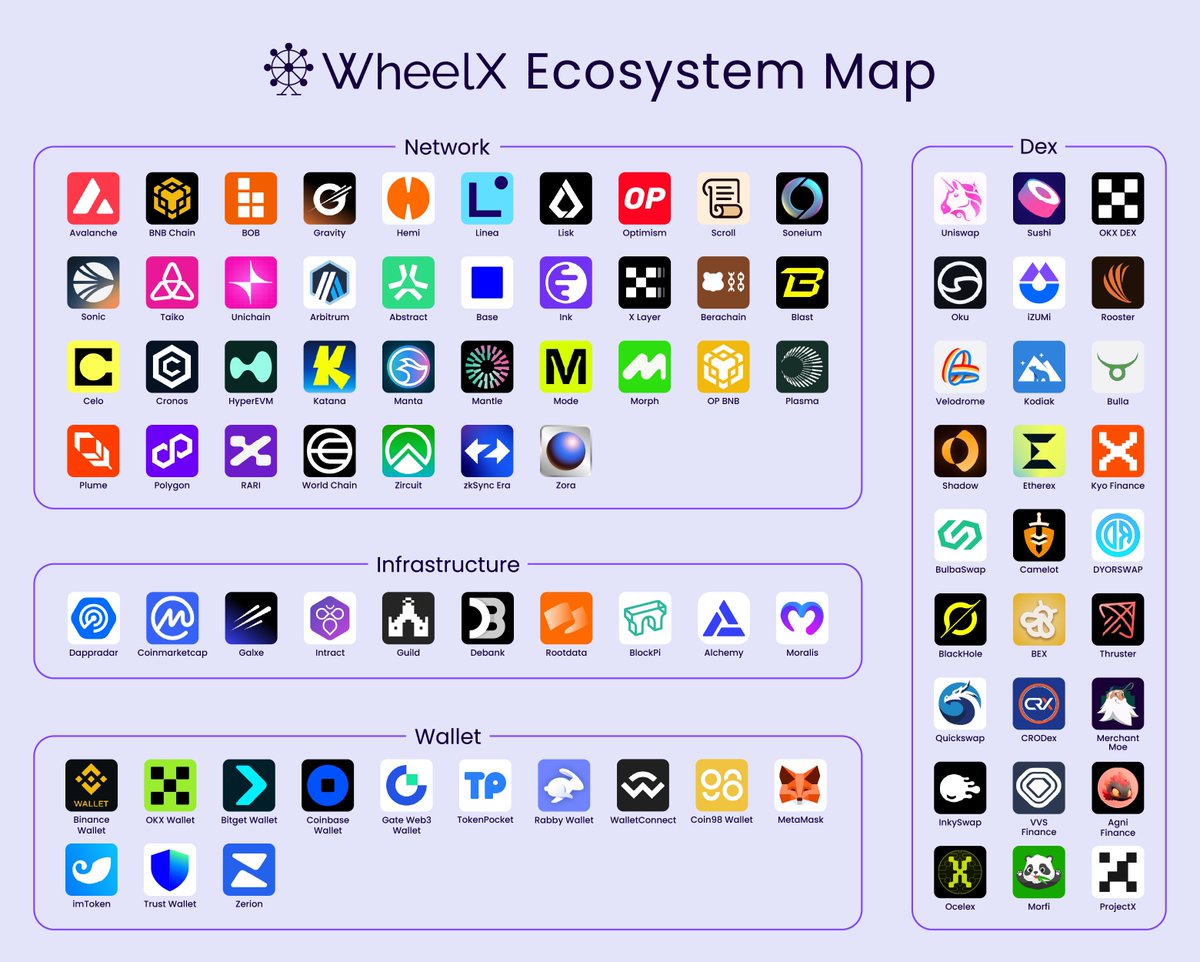
- Connected liquidity venues: The aggregator connects to leading DEXs including Uniswap, Curve, Trader Joe, PancakeSwap, Balancer, and others, plus multiple bridge protocols
- Split routing mechanics: For large orders, instead of routing through a single DEX (incurring heavy slippage), the wheelx aggregator splits the order across multiple venues
Example: A $500K swap might route 40% through Uniswap, 35% through Curve, 25% through Balancer
The smart routing engine of WheelX ensures users benefit from lower slippage, reduced transaction fees, and faster execution
AI-powered decision factors
- Real-time price feeds from each DEX
- Historical performance metrics showing best execution for specific token pairs
- Bridge reliability scores based on success rates and confirmation times
- Gas price feeds for each connected chain
- Liquidity depth analysis to verify quoted prices are achievable
Cross-chain native design: Unlike traditional single-chain aggregators (1inch, Paraswap), the WheelX aggregator is inherently cross chain, simultaneously optimizing across multiple networks with different fee markets and liquidity conditions
A key feature of decentralized finance platforms is the ability to streamline complex cross-chain operations, empowering users with greater flexibility in managing their assets
The wheelx aggregator directly enables the wheelx dex and wheelx defi capabilities by serving as the intelligent routing backbone
Wheelx DEX & Wheelx DeFi Ecosystem
The term wheelx dex describes WheelX’s function as an execution layer—not a single AMM with its own liquidity pools, but a meta-DEX that routes through existing on-chain liquidity wherever it provides the best execution. This architecture means WheelX doesn’t compete with DEXs; it enhances access to all of them.
WheelX functions as a meta-DEX and DeFi router rather than a traditional order book or AMM. It leverages on-chain liquidity across dozens of venues without requiring users to know which DEX offers the best rate.
Typical DeFi actions through WheelX
- Cross chain swaps between any supported tokens
- Yield strategy migrations (moving LP positions between chains)
- Portfolio rebalancing across multi chains
- Liquidity migration to capture better opportunities
Broader wheelx defi ecosystem vision
- Integration with money markets (Compound, Aave across chains)
- Connections to liquid staking protocols (Lido, Rocket Pool)
- Routing through perpetuals DEXs and derivatives platforms
- Supporting institutional treasury management workflows
Potential future features
- Intent-based orders where users specify desired outcomes and the system executes when conditions are met
- Limit orders routed across chains
- Gas abstraction using smart accounts and paymaster patterns
WheelX positions itself as infrastructure for wallets, dApps, and institutional desks requiring reliable cross chain interoperability
Strategic partnership opportunities exist with protocols seeking to offer their users seamless multi-chain access
Using Wheelx.fi: Step-by-Step User Journey
This section walks through the typical flow on wheelx.fi for new users navigating the platform in 2025-2026. The interface is designed to abstract complexity while giving advanced users full visibility into routing decisions.
Step 1: Connect wallet
- Supported wallets: MetaMask, Coinbase Wallet, WalletConnect, Rainbow, and others
- Ensure you have gas on your source chain (ETH for Ethereum, MATIC for Polygon, etc.)
Step 2: Select source chain and token
- Choose the network where your assets currently reside
- Select the token and enter the amount you want to swap or bridge
Step 3: Select destination chain and token
- Choose where you want assets to end up
- Select the output token (can be different from input)
Step 4: Review route preview
- Source DEX (e.g., Uniswap v3)
- Bridge selection (automatically chosen based on current conditions)
- Destination DEX (if swap required)
- Expected output amount after all fees
- Maximum slippage tolerance (adjustable)
- Estimated completion time
Step 5: Gas fee review
- Gas on source chain (e.g., ~$2-15 on Ethereum depending on network conditions)
- Bridge fee (varies by protocol)
- Gas on destination chain (often sponsored or minimal on L2s)
- Example: ETH → USDC swap from Ethereum to Optimism might show $8 total fees
Step 6: Security verification
- Verify contract addresses match official WheelX contracts
- Check transaction simulation results
- For large transfers (>$10K), consider test transactions first
Step 7: Execute and track
- Approve token spending (if first time)
- Confirm the transaction
- Track status on wheelx.fi’s history page
- Links to Etherscan, Arbiscan, and other explorers for verification
Security, Audits, and Risk Management in Wheelx DeFi
Cross-chain systems have historically been high-value targets for exploits. Between 2021 and 2024, bridge hacks resulted in over $2 billion in stolen funds, including the Ronin bridge hack ($625M in 2022) and Poly Network exploit ($611M in 2021). Security is therefore paramount for any wheelx defi interaction.
WheelX security measures
- Smart contracts audited by reputable security firms
- Formal verification applied to critical functions where feasible
- Bug bounty programs on platforms like Immunefi
- Real-time monitoring systems for anomaly detection
External integration evaluation criteria
- Total Value Locked (TVL) as proxy for battle-testing
- Comprehensive audit history with public reports
- Incident response track record
- Team reputation and operational transparency
- Code update frequency and quality
User risk management tools
- Route risk labels indicating when paths use less-tested bridges
- Warnings for illiquid tokens that may not be available on destination chains
- Conservative default slippage tolerances
- Transaction simulation before execution
Best practices for users
- Revoke excessive token allowances after use (via Revoke.cash or similar)
- Use hardware wallets for large cross-chain transfers
- Split large transfers into smaller batches to reduce risk exposure
- Verify contract addresses against official documentation
While WheelX improves UX significantly, all DeFi carries inherent smart contract risk, liquidity risk, and market risk—users must understand these before transacting
Wheelx Crypto Tokenomics and Incentives (If/When Live)
Disclaimer: As of 2025-2026, the status of a native WheelX crypto token remains undisclosed. The following represents potential utility based on common DeFi protocol patterns. This is informational only—not financial advice.
Potential token utility
- Governance over protocol parameters (fee structures, bridge integrations, routing preferences)
- Fee discounts for users holding tokens when executing wheelx swap routes
- Incentives for liquidity partners and ecosystem integrators
User reward mechanisms (speculative)
- Fee rebates for frequent cross chain activity
- Points programs convertible to governance rights
- Priority routing for token holders during high-congestion periods
Value accrual possibilities
- Protocol fees from aggregated trades
- Revenue sharing with integrators
- Funding for continued development, audits, and ecosystem grants
Distribution considerations
- Community allocation rewarding early users and testers
- Ecosystem fund for incentivizing integrations and collaboration
- Team allocation with multi-year vesting schedules
- Investor allocation proportional to funding rounds
Always verify the latest official token information directly on wheelx.fi and reputable data aggregators before making any decisions
Developers & Integrations: Building on Wheelx.fi
WheelX positions itself as infrastructure for wallets, DeFi dashboards, and dApps requiring cross-chain functionality. The platform is designed to be integrated once and deployed across multiple enterprise partners without needing to rebuild code or clinical workflows.
Available developer tools
- REST APIs for querying routes, prices, and execution status
- SDK packages for JavaScript/TypeScript integration
- Smart contract ABIs and integration examples
- Testnet environments for building and testing
Common integration examples
- Non-custodial wallets adding “cross chain swap” buttons powered by WheelX
- Portfolio trackers (Zapper, Zerion-style) using WheelX for rebalancing
- NFT marketplaces enabling payment in any chain’s native token
- GameFi projects moving in-game rewards between networks
- Institutional treasury tools managing collateral across blockchains
Developer resources
- Testnet faucets and documentation
- Example repositories and code snippets
- Support channels (Discord, Telegram)
- Public roadmap for upcoming cross chain interoperability features
WheelX provides immediate access to a network of partners seeking integration solutions for their multi-chain needs through strategic partnership and collaboration
Developers can focus on their core product while WheelX handles the complex execution layer
Future of Cross Chain Interoperability With Wheelx
The growth of rollups, appchains, and modular infrastructure (Celestia, EigenLayer, and similar projects) is accelerating the need for powerful routing layers like WheelX. As blockchain architectures become more specialized, the coordination layer becomes increasingly valuable.
- Evolution toward intent-centric architectures: Users will specify desired outcomes rather than exact execution paths, with WheelX’s AI-powered platform handling optimal fulfillment
- Account abstraction integration: Gas abstraction and programmable wallets will make cross-chain transactions feel like single-chain operations
- Long-term vision: Making chains effectively invisible to end users while maintaining decentralization and user custody
Potential ecosystem expansion
- zk-rollups (zkSync, Scroll, Linea)
- Modular execution layers built on data availability solutions
- Non-EVM chains where technically feasible
WheelX aims to be a core piece of the multichain DeFi stack, powering both retail and institutional cross chain flows through strategic partnership and continuous collaboration with ecosystem partners
Next steps: Explore wheelx.fi, experiment with small cross chain swaps to experience the platform firsthand, and follow official channels for updates on new chain integrations and features
Cross-chain DeFi doesn’t have to be complicated. With WheelX handling bridge selection, route optimization, and execution, users can focus on their strategies rather than infrastructure logistics. Start with a small test transaction, verify the experience matches your expectations, and scale up as you build confidence in the platform.